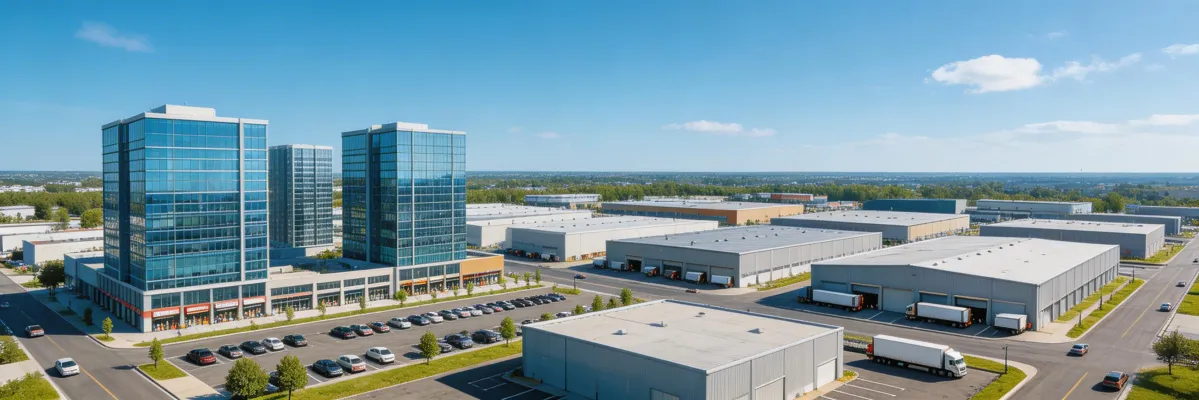
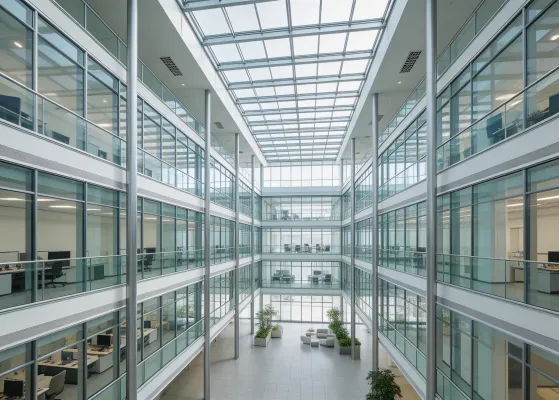
Office towers, retail centers, and mixed-use developments demand zoned HVAC with variable air volume and precise humidity control. Our variable-speed heat pumps and fan coil units deliver occupant comfort while reducing energy costs by 25-35% compared to constant-volume systems.
A 28-story, 45,000 m2 Class A office tower with variable occupancy ranging from 30% to 95% across floors required precise zone control and energy efficiency to achieve LEED Gold certification. LennoxAir deployed water-source heat pumps with inverter compressors across 112 independently controlled zones, connected via BACnet to the building's Honeywell BMS. The system operates at a weighted annual COP of 4.6 and achieved a 32% reduction in HVAC energy consumption compared to the ASHRAE 90.1-2019 baseline, contributing 12 LEED energy optimization points.
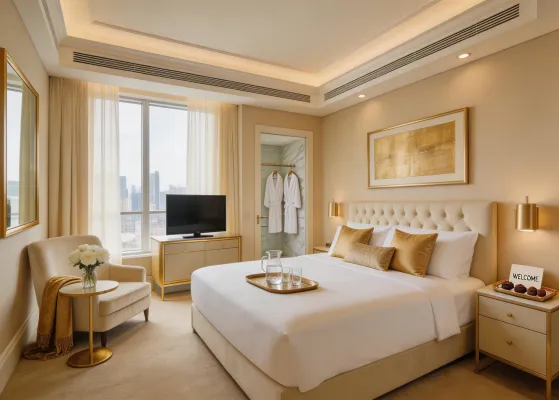
Hotels, resorts, and convention centers require ultra-quiet HVAC systems that maintain guest comfort across hundreds of individually controlled rooms. Our packaged terminal heat pumps and water-source systems deliver consistent performance with sound levels below 35 dB(A) in occupied spaces.
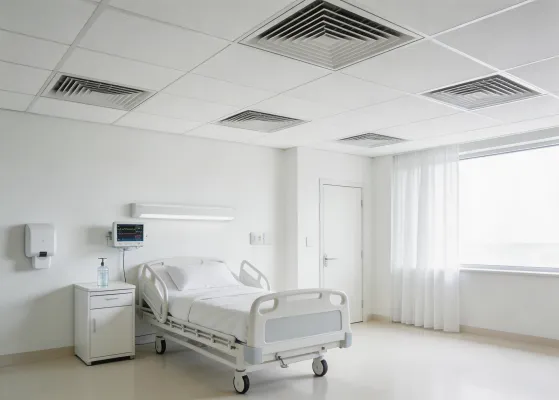
Operating rooms, isolation wards, and pharmacy storage demand HVAC systems meeting ASHRAE 170 ventilation standards with redundancy for critical areas. Our air handling units provide HEPA filtration, precise temperature control to +/- 0.5 degrees C, and positive/negative pressure management.

Schools and universities face extreme seasonal load swings and tight maintenance budgets. Our rooftop package units and split heat pump systems deliver reliable performance across classrooms, laboratories, and gymnasiums with minimal maintenance overhead.
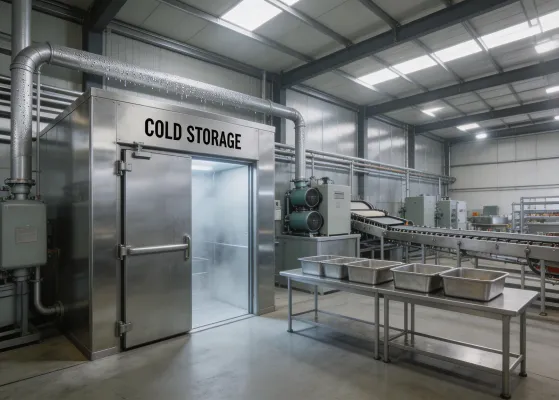
Process cooling, blast freezing, and ambient temperature control for production lines require robust refrigeration with HACCP compliance. Our condensing units and evaporator coil systems handle temperature ranges from -40 degrees C freezing to +18 degrees C storage with precise control and rapid pull-down capability.
A 12,000 m2 dairy processing facility required simultaneous cooling at three temperature zones: +4 degrees C raw milk storage, -2 degrees C aging rooms, and -25 degrees C frozen product storage. LennoxAir configured a cascade refrigeration system using R-744 (CO2) for the low-temperature stage and R-134a for the medium-temperature stage, achieving a combined system COP of 3.8. The heat recovery loop captures condenser waste heat to preheat process water to 55 degrees C, reducing the facility's gas boiler consumption by 22%. The system was commissioned in 14 weeks with a 72-hour performance verification confirming all temperature zones held within +/- 0.3 degrees C of setpoint under full production load.
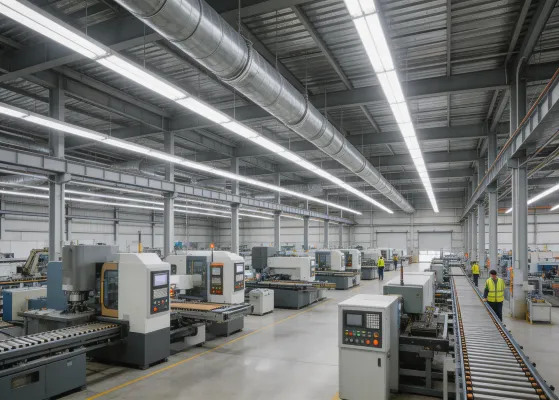
Manufacturing floors, assembly lines, and warehouses generate significant internal heat loads from machinery and processes. Our ventilation and process cooling systems maintain worker comfort and product quality while managing heat rejection efficiently across large open-plan facilities.
Choosing the right HVAC architecture involves trade-offs between capital cost, operating efficiency, and application requirements. Two common decision points our engineers help clients navigate:
Inverter-driven compressors modulate capacity from 25% to 100%, delivering 30-50% energy savings in variable-load applications like commercial offices and hotels. They also provide soft-start capability that reduces mechanical stress and inrush current.
Fixed-speed compressors cost 20-30% less upfront and offer simpler controls and maintenance. They remain the preferred choice for constant-load applications such as industrial process cooling and ice production, where the compressor runs near full capacity most of the time.
Breakeven point: For facilities with load profiles below 60% capacity for more than 40% of annual operating hours, inverter models typically achieve payback within 2-4 years through energy savings alone.
Air-cooled heat pumps and chillers eliminate cooling tower maintenance, consume zero water, and simplify permitting. They are well suited for facilities in water-scarce regions or where rooftop installation space is available, with typical COP values of 2.8-3.5.
Water-cooled systems achieve higher COP (5.0-6.0), better part-load efficiency, and longer equipment life. They are preferred for large installations above 500 TR, data centers, and process cooling where the lifecycle energy cost justifies the additional infrastructure investment in cooling towers and condenser water piping.
Decision factor: Water availability, local utility rates, building height restrictions, and maintenance staff capacity all influence which architecture delivers the lowest 15-20 year total cost of ownership.
Our engineers have configured HVAC systems for museums, data centers, pharmaceutical labs, and dozens of other specialized environments. Talk to us about your requirements.
Contact Our Engineering Team